POSTS
A Mantra for Daily Reviews
by Luis P. Prieto, - 6 minutes read - 1202 wordsDo you check your daily to‑do list at the end of the day? If not, you probably should. Yet, this healthy habit can lead to an increasing sense of dissatisfaction and/or shame, as we are prone to plan more tasks than we are realistically able to execute (due to a very human bias). Do we have to choose between productive habits and a positive self‑image? This post introduces a “mantra question” I am using lately to maintain focus during daily reviews.
As part of my “New Year overhaul” process (not a New Year’s resolution), I am trying to re-introduce a few healthy and productive habits into my routines, which had deteriorated during the Fall/Winter semester (including writing and posting more frequently to this blog!). Nothing major, more of a “back to basics” dynamic.
A key productivity habit I’m working on is a consistent “shutdown routine” and daily review. This simple habit, which takes 5-10 minutes each day, consists of:
- reviewing any “open loops” (fragmentary notes or tasks captured during the day), adding them to our “master to-do list” (whatever form it takes),
- revising the daily to-do list to mark completed tasks and decide whether to reschedule, delegate, or abandon the rest
- writing a small chronicle or reflection for the day, and
- planning the next day, in terms of looking at our appointments (in the calendar app) and setting a small to-do list of tasks to be done that day (taking into account the other commitments we have). Optional, but recommended: prioritize these next-day tasks (e.g., define one/few Most Important Tasks, or MITs) and/or place them at specific times in the calendar to be executed, as if they were “appointments with oneself”.
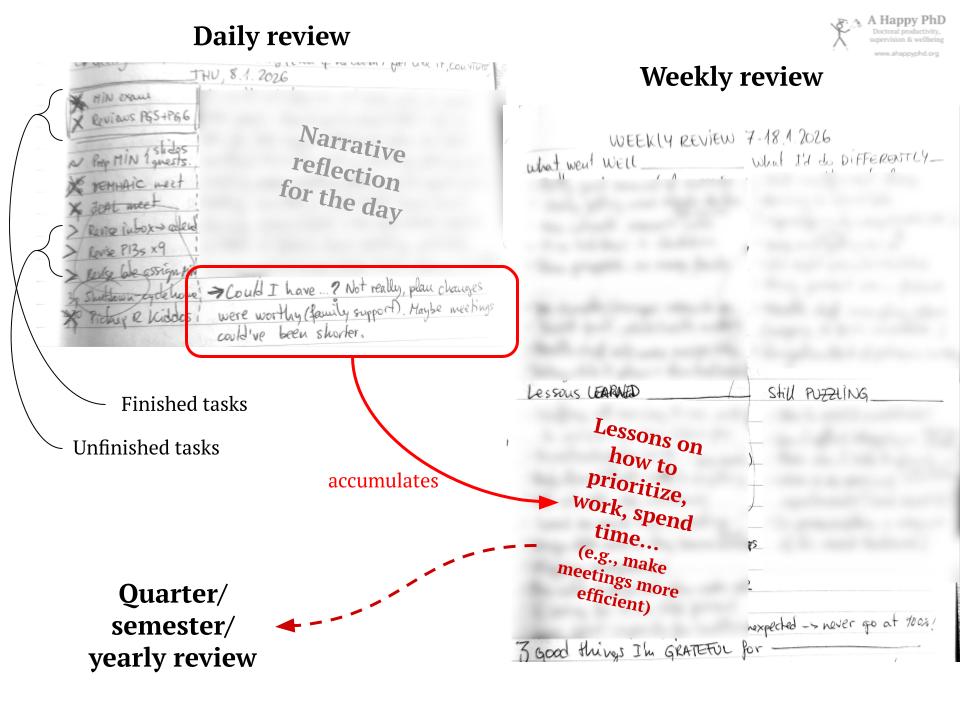
This “ritual” is a key element of my productivity system and a standard recommendation in our doctoral workshops. Yet it presents two problems: a) aside from a simple chronicle of events (or feelings), which may not be very consequential, it is unclear what to reflect upon in step #3 (I dislike totally freeform “reflection”, as it is often unproductive and prone to all sorts of biases); and b) revising the daily to-do’s (step #2) and finding that I almost never accomplish even the simple list I set for the day leads to a sense of dissatisfaction, regret, and/or shame. This latter problem is quite normal, I know, due to the planning fallacy1, but that does not remove the negative affect it conveys to the whole review (which I suspect is partly behind my lack of consistency in doing this simple practice, especially during stressful periods of academic life).
To solve these two problems, lately I have introduced a simple “question mantra” to reflect upon during such daily reviews: Could I have spent my time better today? (and how?)
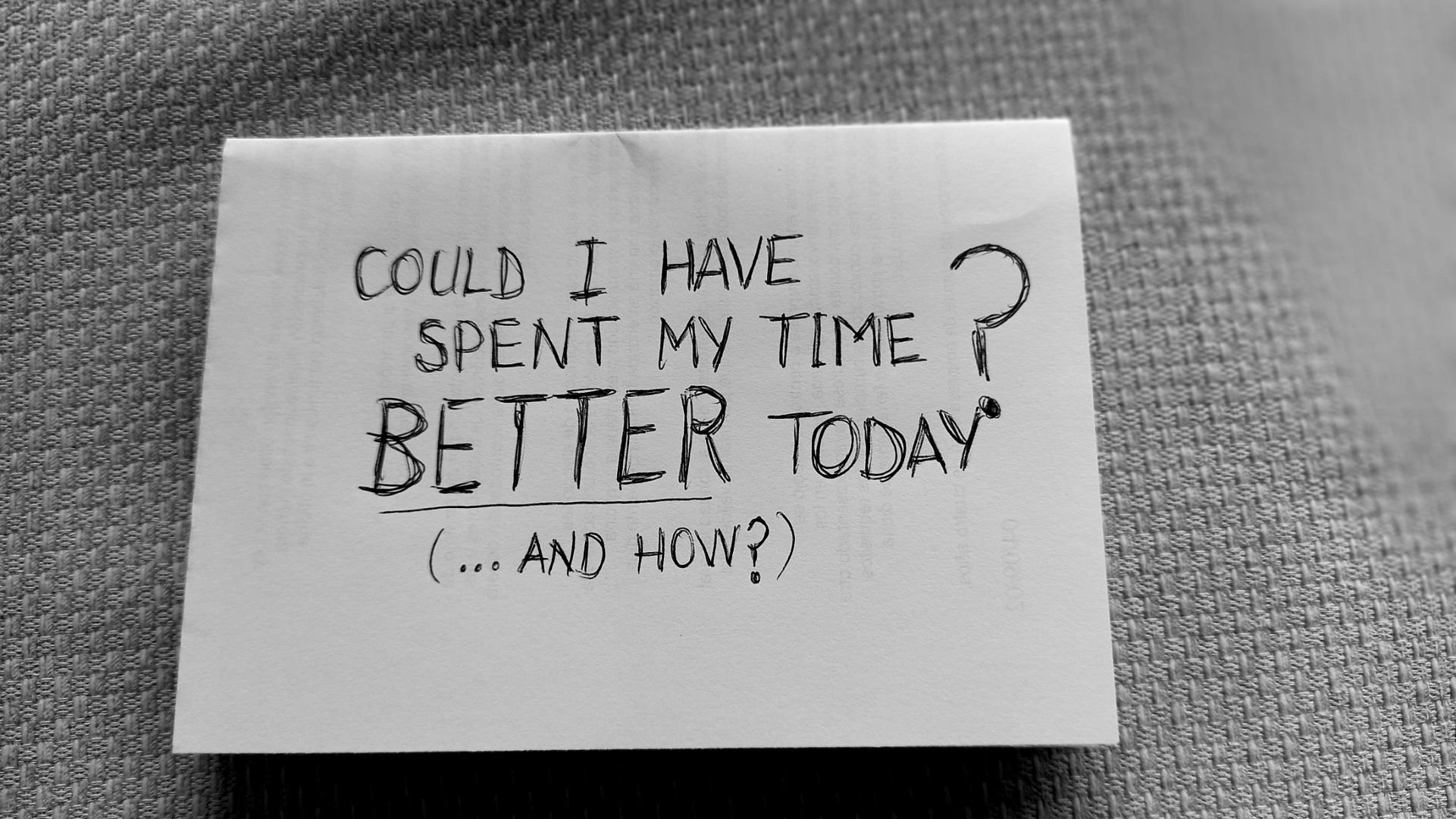
To be clear, this is not about an what we could have done on an ‘ideal day’ with no interruptions, or if we had worked magically faster (we can’t). Rather, it is about what we can do with the actual day we had, its unexpected changes, new information, interruptions, and the time they left us to make progress on things that matter to us. This last bit is important: when answering to this mantra, we need to keep in mind not only our PhD research and its importance (paying special attention, of course, to things that advance us toward our next thesis milestone), but also our whole set of values: what is important for us in life, in general (like being a good friend or daughter or father) or in the current context/season (like “I want to be there for this particular friend who had a breakup and is having a particularly hard time right now”, or “I need to finish designing this research study before the course starts, or I will lose the chance to gather data for another year”).
This question creates a sort of mini-postmortem of the day, from a productivity standpoint. And, in many cases, the answer can perfectly be “No, that was the best I could do, considering my priorities in life”. This postmortem separates plan deviations which are due to important unexpected events (e.g., interruptions from our kids’ school, new information about results of important analysis that prompts follow-up tasks) from procrastination or unimportant interruptions which could/should be avoided (e.g., by going to work to a different place when we need to be focused, next time).
I have not invented this question, but but I cannot recall where I first found it formulated that way. Conceptually, it is a close cousin of the “regret test” (which we have covered as a useful decision making tool), and of Oliver Burkeman’s work about considering our finitude (covered here and here). Its net effect is to shift our mindset from one of shame and regret for “not being enough”, to a growth one (which has plenty of research behind its benefits2).
You may also be asking. OK, now that I made and noted these daily reflections, what are they for? An important aspect of this mantra is how it integrates with the rest of our productivity system (especially, what Cal Newport calls “full-horizon” or “multi-scale planning”). Daily responses to this question (in a notebook, or text file) inform our weekly reviews, allowing us to experiment and change our habits over time. These weekly reflections are in turn revisited in our season or yearly reviews, where they slowly accrete into habits and strategies we use to be productive in ways aligned with our values.
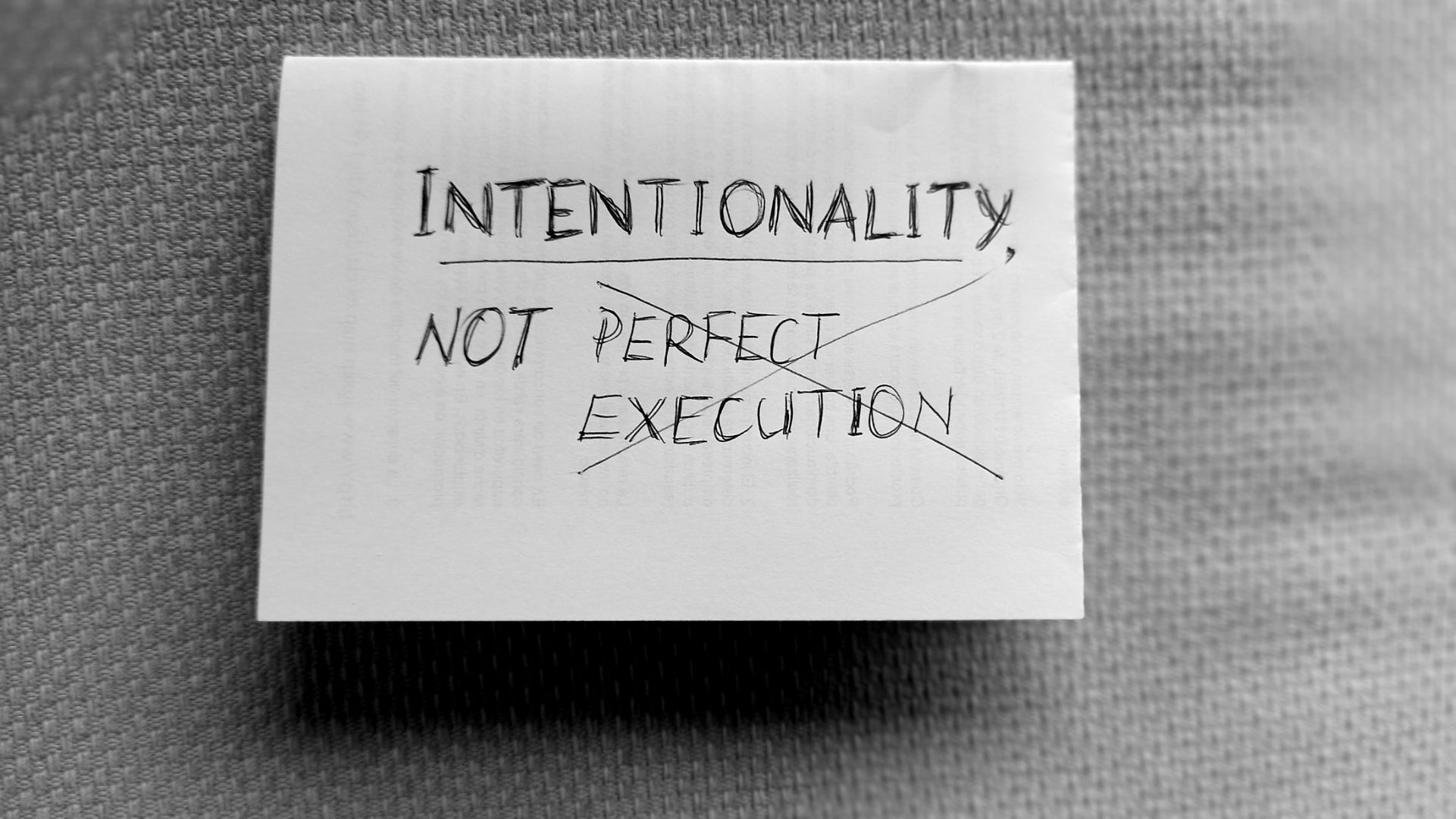
The principle underlying this mantra is simple: maximize intentionality, not perfect execution. This may deserve its own mantra card, as it is applicable not only at the time of the daily review, but throughout the day. Whenever we have a setback or an interruption, we can come back to our daily plan or to-do list, and see what is the best use of our remaining time, that is aligned with our values and our thesis roadmap.
As a chronic overplanner, this tweak helps me move past regret… yet it works equally well for chronic underplanners, giving us direction and helping self-regulate over time.
In the few weeks I’ve been using it, this mantra has made me want to do my daily reviews (rather than seeing it as a necessary chore), and I am being much more consistent with it.
I hope it helps you too.
-
Kahneman, D., & Tversky, A. (1977). Intuitive prediction: Biases and corrective procedures. DARPA Technical report PTR-1042-77-6. Available here. ↩︎
-
Tao, W., Zhao, D., Yue, H., Horton, I., Tian, X., Xu, Z., & Sun, H. J. (2022). The Influence of Growth Mindset on the Mental Health and Life Events of College Students. Frontiers in psychology, 13, 821206. https://doi.org/10.3389/fpsyg.2022.821206 ↩︎
-
The prompt I used was: “Create an expressionist oil painting of a doctoral student in a labcoat, sitting in the sunset at 8pm (show a digital clock), thinking about two counterfactuals of their past selves: one working at the lab at 6am, another looking at their smartphone. Make the image 16:9 aspect ratio” ↩︎

Luis P. Prieto
Luis P. is a Ramón y Cajal research fellow at the University of Valladolid (Spain), investigating learning technologies, especially learning analytics. He is also an avid learner about doctoral education and supervision, and he's the main author at the A Happy PhD blog.